Jardines Galleries · Tokens & medals · c.1815 – 1816 · London Missionary Society · Halliday dies · Numista Rarity 97
Griqua tokens.
c.1815 – 1816 · The first coinage struck for a South African peopleOne of the most enigmatic issues in South African numismatics. Commissioned by the London Missionary Society for use at Griquatown — these are considered the first coinage struck for and used by a South African people. Four denominations — ¼d and ½d in copper, 5d and 10d in silver — were struck in England by Thomas Halliday on the initiative of Rev. John Campbell. They circulated for less than two years before being withdrawn and melted; the survivors carry a Numista Rarity Index of 97. For adjacent token material, see Concentration Camp Tokens.
Campbell's experiment
London Missionary Society · Klaarwater / Griquatown · ~1,200 Griqua populationThe Reverend John Campbell of the London Missionary Society believed coinage could be "a means to introduce Western civilisation to the Griqua". At his own expense he commissioned four denominations from Thomas Halliday, the London die sinker.
The Griqua were a mixed-race people of European, slave and Khoikhoi (Hottentot) elements, settled north of the Orange River near present-day Kimberley. Population ~1,200. Campbell's vision: a Christian civilising tool, fronted by the LMS dove emblem.
"Shrouded in mystery"
Most evidence: they never circulated · Failed experiment · Coins withdrawn and meltedMissionary Heinrich Helm wrote that the Griqua refused them. Griqua leader Waterboer was paid in rixdollars, not tokens. There was no store or bank to exchange them. Historian J.S. Marais's authoritative Cape Coloured People 1652 – 1937 makes no mention of any coinage in Griqua Town.
The experiment failed. A few years later the coins were gathered together and melted down. A few survived — trial strikes, proofs — and these have become valuable and intriguing numismatic pieces.
Overview
LMS commission · "Christian coinage" · Klaarwater / Griquatown · Northern CapeThe Griqua tokens were commissioned by the London Missionary Society (LMS) for use at their mission station at Griquatown (formerly Klaarwater) in the Northern Cape. The coins are undated but are generally attributed to c.1815 – 1816. They are sometimes called "Christian coinage" because of the dove emblem — the symbol of the London Missionary Society.
According to the authoritative reference Hern's Handbook on South African Coins and Patterns, these coins were first used by the Griqua people in the Klaarwater district near Kimberley and did not circulate for more than two years before being withdrawn and melted down.
The history · Reverend Campbell's experiment
The commission · The circulation controversy · The failureThe commission
Rev. John Campbell · Halliday dies · Two batches procuredThe Griqua were a mixed-race people of European, slave and Khoikhoi (Hottentot) elements. By the second decade of the 19th century, the tribe had settled on land granted to them by the government of the Cape Colony north of the Orange River, close to present-day Kimberley. The Griqua population was about 1,200.
The Reverend John Campbell of the London Missionary Society believed that coinage could be used as a means to introduce Western civilisation to the Griqua. Apparently at his own expense, Campbell arranged for four denominations of coins to be struck in England. The dies were designed and sunk by Thomas Halliday. It is believed that the first batch was procured in 1815 and a second a year later; but the number of coins in each batch is unknown.
The circulation controversy
Gunning (1910) · Helm · Waterboer · Marais · "Never circulated"In 1910, Dr. J.W.B. Gunning, Director of the Transvaal Museum, wrote: "De geschiedenis dezer munten is min of meer in duister gehuld" — the history of these coins is somewhat shrouded in mystery. The exact year of minting, the years they were in use, and the amount circulated are all unknown.
Most evidence suggests they never effectively circulated:
- Missionary Heinrich Helm wrote that the Griqua refused to accept them
- There was no store or bank to exchange them
- Griqua leader Waterboer refused them and was paid in rixdollars
- An article published on tokencoins.com states the coins "never circulated in the interior of South Africa between [the years] 1815 to 1820 or at any other time"
- Historian J.S. Marais, in The Cape Coloured People 1652 – 1937, makes no mention of any coinage being used in Griqua Town
The coinage must have been regarded as a failed experiment and a few years later the coins were gathered together and melted down. A few survived — including trial strikes and proof examples — and these have become valuable and intriguing numismatic pieces.
Specifications
Four denominations · Common obverse · Hern GT1 – GT4 · Halliday design| Denomination | Metal | Weight | Diameter | Edge | Reference |
|---|---|---|---|---|---|
| 10 Pence (10d) | Silver | 4.19g | 25mm | Oblique milling | Hern GT1 |
| 5 Pence (5d) | Silver | 2.1g | 18mm | Oblique milling | Hern GT2 |
| Half Penny (½d) | Copper | ~4.0g | 22mm | Reeded | Hern GT3 |
| Quarter Penny (¼d) | Copper | 3.63g | 20.76mm | Reeded | Hern GT4 |
- — Common obverse —
- Emblem of the London Missionary Society — a flying dove with an olive branch in its beak, designed by Thomas Halliday
- — Reverse —
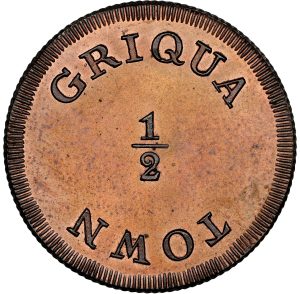
- The word "GRIQUA" in an arc above · denomination in centre · "TOWN" inverted in an arc below
Rarity & auction records
Numista Rarity 97/100 · London Coins · Heritage NYINC · Nomisma SpaThe Griqua tokens are exceptionally rare. The Numista Rarity Index, which calculates based on collector collections, stands at 97 out of 100 — meaning it is among the rarest items collected. Genuine examples command four-figure prices in modest grade and five figures at mint state.
| Denomination | Grade / condition | Auction | Date | Price realised |
|---|---|---|---|---|
| 10 Pence Silver | Approaching EF | London Coins Auction 173 | 2021 | £2,400 |
| 10 Pence Silver | Choice mint state | Australian auction | 2007 | AU$17,250 |
| 10 Pence Silver | MS63 NGC | Heritage NYINC 3121 | Jan 2025 | Estimate $3,000 – 5,000 |
| 5 Pence Silver | MS63 NGC | Heritage NYINC 3121 | Jan 2025 | Estimate $3,000 – 5,000 |
| ½ Pence Copper | MS64 Red & Brown NGC | Heritage NYINC 3121 | Jan 2025 | Estimate $3,000 – 5,000 |
| ¼ Pence Copper | MS62 Brown PCGS | Heritage NYINC 3121 | Jan 2025 | Estimate $2,000 – 4,000 |
| Complete set (4 coins) | Uncirculated (FDC) | Nomisma Spa Auction 50 | 2014 | — exceptional conservation |
2015 bicentennial commemoratives
SA Mint · Gold Reef City Mint · 200 years · "Coins about coins"In 2015, the South African Mint and the Gold Reef City Mint (for the National Numismatic Society) issued commemoratives marking 200 years of the Griqua Town coinage. The SA Mint range was launched at Coin World; the NNS/GRCM commemorative set was issued at their annual dinner on 5 March 2016. Together these are sometimes described as "coins about coins" — designs replicating the 1815 originals in modern proof and bullion formats.
SA Mint official issues
R5 circulation · R2 silver crowns · R2 ¼oz gold · Magnifying-glass packagingThe South African Mint, a wholly owned subsidiary of the SARB, launched a commemorative circulation R5 coin and a range of numismatic products. The Griqua Town R5 circulation coin was the fourth commemorative R5 issued since the first bi-metal R5 was introduced in 2004. It was introduced into circulation from early 2016. Three numismatic products were available at Coin World:
- R5 proof-quality coin
- Bears on the reverse a rendition of the two sides of the original 5 pence 1815 Griqua coin, slightly overlapped
- Obverse: national coat of arms, "2015"
- Packaged with magnifying glass in PVC box
- Two R2 sterling silver crown-size coins
- Uniquely designed, each featuring half of the obverse design of the original Griqua Town coin
- When the two coins are overlapped, they form one complete image of the original
- Packaged with R5 proof and magnifying glass in hand-crafted wooden box
- R2 ¼ ounce 24 carat gold coin
- Reverse: partial image of the obverse 1815 coin (dove with olive branch), "1815 bicentennial 2015" and "Coinage of Griqua Town"
- Part of the 200 limited-edition sets including R5 proof, two R2 silver crowns, magnifying glass, hand-crafted wooden box
NNS & Gold Reef City Mint issue
Laidlaw 1041a · Annual dinner · 5 March 2016 · Four pieces · Die errorsThe National Numismatic Society, in conjunction with the Gold Reef City Mint, issued a commemorative medal set in 2015 (Laidlaw 1041a). The set was issued at their annual dinner on 5 March 2016 together with a replica set (Laidlaw 1041b).
Specifications
- 10 Piece — 38.6mm fine silver, 31.3g — $30
- IIIII Piece — 32.7mm fine silver, 15.7g — $10
- ½ Piece — 38.7mm copper, 29.7g — $15
- ¼ Piece — 32.7mm copper, 17.7g — $5
- Cased set of four — $65
Design & errors
- Obverse — replica of the obverse of the Griqua Town coinage. Legend: "BI-CENTENNIAL OF THE GRIQUA TOWN COINAGE" and "1815 – 2015"
- Reverse — replica of reverse. Denomination (10, IIIII, ½ or ¼) between "GRIQUA" and "TOWN". Legend: "THE FIRST COINAGE FOR A SOUTH AFRICAN PEOPLE". At foot: "GRC-NNS"
- Die errors — "CENTENNIAL" spelled with two N's (CENTEN(N)IAL); letter A inverted as V; "GRC-NNS" missing on reverse of IIIII piece
The medals come in a heavy oblong wooden fitted case, embossed on the outside of the lid with the image of both sides of the 10 piece and "1815 – 1816". Souvenirs of off-metal and off-size medallions were given to those attending the dinner.
Postscript · the 1890 Victoria penny patterns
KM-X9 · Hern-GT21 · Patterns only · SP64 sold $1,600 (2024)In 1890, patterns for a Victoria penny were minted in copper and nickel (KM-X9 Hern-GT21). These were not issued for circulation but are collected as patterns. A specimen graded SP64 Brown PCGS sold for $1,600 in August 2024.
Sources
Auction archives · Hern · Numista · Mint press releases- London Coins Auction 173 (2021)
- South African Mint — official press releases (2015 – 2016)
- Business Tech (Dec 2015). "This is what the new R5 coin looks like"
- South African Medals website — Laidlaw 1041a
- Numista — Griqua Town ¼ Penny (1815 – 1816)
- Heritage Auctions NYINC Signature Sale 3121 (January 2025)
- CoinArchives — various Griqua token auction results
- Nomisma Spa Numismatic Auction 50 (2014)
- Sandton Chronicle (Dec 2015). "New Griqua Town coin range revealed"
- Marais, J.S. The Cape Coloured People 1652 – 1937
- Hern, Brian, Bothma, John & Peterse, Hercie. Hern's Handbook on South African Coins and Patterns 2017/18 (9th ed.)
Library cross-references
Token cluster · Adjacent issues · Griqualand-EastConcentration camp tokens & notes
The other major token cluster — Bellevue, Green Point, Diyatalawa, the "SCUM OF THE SCUM" medal. Different era (Anglo-Boer War), same library cluster of token / medal material.
— Later Griqua issue —Griqualand-East £1 note
The Griqua paper-currency story doesn't end with the LMS tokens — see the 1868 Griqualand-East £1 note from the eastern Griqua settlement. Different region, same cultural thread.
— Same broad era —Pre-1921 Banknotes
The free-banking era — ~30 private banks, ZAR government notes, siege notes. Same broad pre-SARB period as the Griqua experiment.
— Library home —The Library
The full numismatic library — 80+ pages across coins, banknotes, medals, tokens, grading, and counterfeit detection.