ZAR Coinage · The Last Stand
The 1902 Veldpond.
The last coin of the Boer Republic. Struck in the field at Pilgrim's Rest in the eastern Transvaal during the closing months of the Anglo-Boer War — by a former schoolteacher, with hand-engraved dies, on a press operated by two men of human muscle. 986 minted. Production ended fifteen days after the truce was signed.
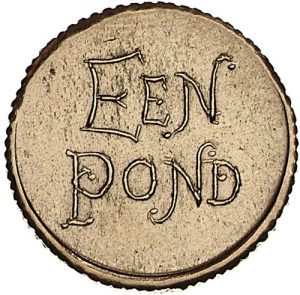 Obverse · ZAR Monogram
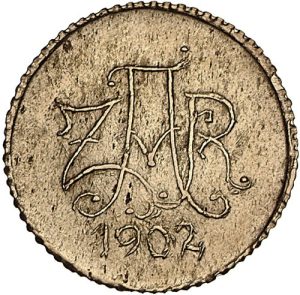 Reverse · Een Pond
The story
Three Acts · The Retreat, The Schoolteacher, The TrucePure 24-karat gold was melted and cast into blanks, shaped into coin form on a manually operated lathe. The gold was nearly pure but proved brittle. Kloppers — the schoolteacher — discovered he could use antiseptic tablets (sublimate of mercury) found in an ambulance to render the gold malleable.
— On the minting of the Veldpond, 1902
The minting
The Gold · The Dies · The PressThe gold
Sourced from the local mines of the eastern Transvaal — nearly pure 24-carat gold, melted and cast into blanks, then shaped into coin form on a manually operated lathe. The metal was too pure to strike cleanly. Kloppers solved the problem with mercury tablets found in an ambulance — a piece of improvised metallurgy that any modern metallurgist would recognise as sound, if astonishing, practice.
The dies
Cut by hand by a former schoolteacher with no die-sinking experience. Six pairs broke during tempering — the rapid quench in oil or water that hardens steel dies. The seventh pair held. Every one of the 986 Veldponde was struck from that single die-pair. One die-pair, no margin, no second chance.
The press
A handmade collar produced the milled edge — so that the Veldpond would carry the same authority of finish as the British sovereign it was meant to supplant. The press itself required two men, working together, to apply the strike. Three months of production. Roughly ten coins per day. Human muscle as the final mechanism of a republic's last currency.
The slash variety
A Cracked Die, RecordedA documented variety
One die. One slash. The most collectable Veldpond.
At some point during the three months of production, the obverse die became notched — a small but visible flaw that left a diagonal "slash" in the upper-left field of the coins struck after the damage occurred. The damage was not repaired. Kloppers had no spare die. The slash was struck for the remainder of the production run.
For modern collectors, the slash variety is the most desirable form of an already extraordinary coin. It places the example unambiguously in the second half of the production run — the period after the die had aged, when the Republic itself had little time left. Slash-variety Veldponde realise material premiums above non-slash examples in equivalent grade.
The off-centre strikes, irregular thickness, and varying weight (7.0 – 8.5 g, against a 7.7 g target) on many surviving examples are not die varieties — they are the visible marks of a primitive press operated under field conditions. They are not faults. They are the coin's signature.
Technical reference
Specifications & Catalogue- Denomination1 Pond (implied)
- Year1902
- MintField mint, Pilgrim's Rest
- Die-sinkerP. J. Kloppers
- Mintage986
- Estimated survival350 – 400
- Composition~.999 Gold (variable)
- Weight7.0 – 8.5 g (typically 7.6 – 7.9 g)
- Diameter21 – 23 mm (typical 22.8 mm)
- EdgeReeded (handmade collar)
- Die alignmentMedal · ↑↑
- CatalogueKM #11 · Hern Z54 · Fr-4
The obverse
Hand-engraved "ZAR" monogram — Zuid-Afrikaansche Republiek — above the date "1902". Simple lettering, no portrait, no allegory. The monogram itself is small, defiant, and functions as both signature and shield.
The reverse
"EEN POND" — One Pound — in two lines. Crude lettering consistent with field conditions. No ornament, no border legend. The reverse is the only place the denomination appears on the coin.
Survival & authentication
Read This Before You Buy OneThe survival
986 struck · roughly 350 – 400 today
- Total survival Estimated 350 – 400 specimens from the original mintage of 986. Many were lost, melted, or damaged in the post-war years.
- Common condition issues Mounting damage (ex-jewellery), plugging (filled holes), and cleaning. Problem-free examples are extremely rare.
- Institutional holdings The Smithsonian Institution holds a specimen — NU.68.159.5817 — from the Josiah K. Lilly estate.
The counterfeit risk
Why the Veldpond is targeted
- The crudeness helps the forger The hand-engraved dies and irregular strike of the genuine coin are difficult to distinguish from a deliberately-aged forgery without expert examination.
- Certification is essential Third-party grading by NGC or PCGS is the only reliable authentication path. Uncertified Veldponde at attractive prices should be treated with extreme caution.
- Diagnostics worth knowing Genuine examples have medal alignment (↑↑), exhibit consistent gold colour and density, and show production-era surface marks. Most modern fakes are too clean.
Auction landmarks
Twenty Years of RealisationsThe Veldpond has shown steady, strong appreciation across two decades — from £14,500 at Noonans in 2005 to over $45,000 at Heritage in 2023 for the right MS65 example. The slash variety commands clear premiums; problem-free Mint State examples are encountered only once every few years.
| Date | House | Grade | Realised |
|---|---|---|---|
| Aug 2025 | Heritage 3125 | NGC MS65 | $30,000 |
| Jan 2025 | Heritage 3121 | NGC MS65 · slash variety | $33,600 |
| Jan 2025 | Heritage 3121 | NGC MS62 | $15,600 |
| Aug 2024 | Heritage 3118 | NGC MS65 | $33,600 |
| Aug 2024 | St. James's | — | £38,000 · $49,400 |
| Jan 2023 | Heritage 3105 | NGC MS65 | $45,600 |
| Jan 2023 | SBP / Shouxi | NGC MS63 | $15,600 |
| 2023 | Schulman | — | €28,000 · $30,800 |
| 2022 | Noonans | — | £27,000 · $35,100 |
| Aug 2020 | Heritage 3085 | NGC MS61 | $28,800 |
| Aug 2020 | Heritage 3085 | UNC Details (Mount Removed) | $7,500 |
| Nov 2020 | Heritage 3088 | NGC MS64 | $33,600 |
| 2015 | Heritage | NGC MS63 | $39,950 |
| Jun 2014 | Dix Noonan Webb | EF | £8,400 · $14,099 |
| 2011 | Noonans | NGC MS64 | £31,000 · $50,000+ |
| 2010 | Heritage | NGC MS64 | $33,600 |
| 2005 | Noonans | — | £14,500 |
Further research
The Gold Behind the CoinsA dedicated research piece
The gold behind the coins
For a deeper investigation into the gold sources used for the Veldpond and the 1892 Berlin-struck ZAR coinage — including the Witbank coalfield connection, the Pilgrim's Rest mines, and the metallurgy of wartime gold — see the dedicated research page on the sources of South African gold and the birth of the Veldpond.
The references
Standard Sources- Coin World"Veld Pond from Anglo-Boer War a major South African rarity" — February 2015 reference article.
- Heritage AuctionsNYINC Signature Sales 3105 (2023), 3118 (2024), 3121 (2025), 3125 (2025).
- Stack's Bowers / Shouxi"Second Boer War Veld Pond, 1902" — January 2023 sale.
- Smithsonian Institution"1 Veld Pond, South African Republic, 1902" — accession NU.68.159.5817, ex-Lilly estate.
- Numista & ColnectReference catalogues — "1 Pond Veld Pond" / "1 Pound (Veld Pond)."
- London Coins archiveRealised prices, Auctions 144, 147, 150, 152.
- Noonans MayfairAuction archive — Lot 467 (June 2011); various lots 2005, 2014, 2022.
- Schulman B.V. & St. James'sEuropean auction records, 2023 – 2024.
- Berlin MünzkabinettReference photography (museum-digital).