Featured · From the Curatorial Desk
Anatomy of the Single 9, 1898.
One coin. One overstamp. One unique presentation piece — and the archival research that is still rewriting how it came to be. The story of the most prestigious coin in South African numismatics, and what its diagnostics still teach us today.
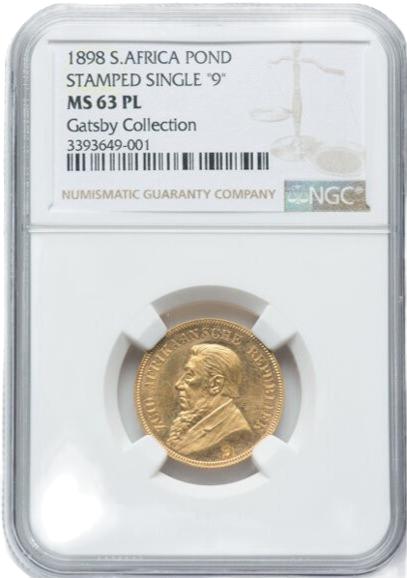
Republic gold "9" Pond, 1898. NGC MS63 Prooflike. Pretoria Mint.
There is no second example. That is the simplest way to understand the Single 9 — and the hardest fact for a collector to fully absorb. Of all the great rarities in South African numismatics, only this one is genuinely unique: a single coin, struck once, presented once, and tracked across continents and a century by a small group of people who understood exactly what they were holding.
What most accounts get wrong is the impression that the Single 9 is an accident. It isn't. It is the deliberate, traceable response to a wartime emergency — and reading it correctly requires understanding the morning of 2 November 1899 at the Pretoria Mint, less than a month after the outbreak of the Second Anglo-Boer War.
The mint without 1899 dies
By late 1899 the Zuid-Afrikaansche Republiek had been minting its own gold currency at Pretoria for seven years, working from dies cut in Berlin and shipped via the Portuguese port of Delagoa Bay — present-day Maputo. War with Britain broke out on 11 October 1899. Less than a month into the conflict, the Mint Master faced an unglamorous problem: the Pretoria Mint had no dies dated 1899.
The familiar version of this story is the dramatic one — that the next consignment of dies was intercepted by British agents at Delagoa Bay and never reached the Mint. The archival record does not support it. Dr J. Ploeger's research in the South African National Archives, published through the Western Cape Numismatic Society, shows that no record exists of 1899 dies ever being ordered or manufactured. The consignment that was intercepted at Lourenço Marques was dated 1900, not 1899 — and the intercepted shipment only arrived at the port on 6 December 1899, more than a month after the overstamping operation had already begun.
Whatever the precise cause — and the archives suggest the romantic die-interception narrative is, at best, a popular legend — the Mint Master authorised the overstamping of existing 1898 Ponde with a hand-held date punch, applying a "9" above the 1898 date to convert the coin to a 1899 issue.
The first strike, and a problem of geometry
At precisely 10:30 a.m. on 2 November 1899, the first coin was struck. The overstamp was applied to a 1898 Pond already chosen, by report, for its exceptional Prooflike surfaces — a deliberate selection for what was to become a presentation piece.
The "9" punch the Mint had on hand, however, was simply too large. When applied above the existing date, it ran straight into the truncation of President Kruger's bust. The result was visually awkward — and the Mint staff stopped after one coin. They sourced a smaller "9" punch and re-tooled the operation, striking the remainder of the small mintage as the "Double 99" Pond. One hundred and thirty pieces of the Double 99 followed. Of the original — the "Single 9" — there is precisely one.
The Macrum monogram
What turns the Single 9 from an interesting mint-error into a documented historical artefact is what happened next. The coin was presented — a deliberate diplomatic gesture — to the United States Consul General at Pretoria, Mr. C.E. Macrum, as a symbol of the South African Republic's currency sovereignty.
Macrum, by contemporary account and by Winston Churchill's own recollection in London to Ladysmith via Pretoria, was openly sympathetic to the Boer cause. Churchill, captured by Boer forces and visited by Macrum in Pretoria, wrote that he "had not, however, talked with Mr. Macrum for very long before I realised that neither I nor any other British prisoner was likely to be the better for any efforts which he might make on our behalf."
Macrum, before the coin left his possession, had a small letter "M" inscribed on the truncation of Kruger's bust — a deliberate provenance mark. That single inscribed letter is the most important diagnostic on the coin today. It is not damage. It is a signature.
The journey, in six sales
The Single 9 disappeared from public view for half a century after Macrum left Pretoria. It resurfaced at the 1954 Sotheby's auction of the Palace Collections of Egypt — the dispersed possessions of the deposed King Farouk — where it was lotted, with little fanfare and almost no description, alongside eighteen other South African coins. The buyer, Baldwin's of London, was acting for Dr. Froelich of Port Elizabeth.
From there, the trajectory becomes documented:
The 2025 Heritage Auctions sale — at the New York International Numismatic Convention — set the public record. It is the first time the coin has crossed an auction floor with a hammer the world could read in real time. The price was USD 2,160,000 with premium, approximately R 40.10 million at the day's exchange rate.
How to read the coin today
For collectors who will, in all likelihood, never own the Single 9 itself, learning to read it remains useful. Its diagnostics are the diagnostics of every Pretoria Mint Pond overstamped in November 1899 — and the points the eye is trained to find on the unique coin are the same points that distinguish a genuine Double 99 from a forgery, or a high-grade ZAR Pond from a polished one.
- The "9" itself. The single overstamped digit is markedly larger than the small punch used on the Double 99. It runs into the truncation of Kruger's bust — that intersection is the reason the operation was halted. On any genuine "9" overstamp, the punch outline shows ghosting from the underlying date.
- The Macrum "M". A small, hand-engraved letter on the truncation of the bust, applied after striking. Unique to this coin. Any "M" claim must align with Macrum's documented placement and depth.
- Prooflike surfaces. NGC has graded the coin MS63 Prooflike. Pretoria Mint Ponde of this period rarely show full PL surfaces — the selection of this planchet for presentation was deliberate.
- Documentation. The coin trades with two pieces of contemporary correspondence — one by the government assayer J. Perrin, one by Macrum himself — and the 1954 Farouk catalogue. Provenance, not condition alone, anchors its value.
Why this coin matters to every collector
The Single 9 is not relevant only to the small group of people who can bid on it. It is the reference object for South African numismatics. The Kruger bust used on every Krugerrand minted between 1967 and 2016 is, with small modifications, the bust depicted on the Single 9. When you handle a Krugerrand, you are handling Kruger as he was rendered for the most prestigious South African coin ever struck.
And the lesson, for a collector at any level, is not about money. It is about reading the artefact. Every ZAR Pond, every Burgers Pond, every Union Sovereign, every early SARB note carries diagnostics that a careful eye can learn. The Single 9 is simply the most concentrated example: one coin in which a die raid, a diplomatic gesture, an inscribed monogram, and a 71-year journey through six owners are all legible if you know where to look.
That is what the library is for.