Jardines Galleries · 1891 – 2024 · Berlin → Pretoria → Centurion
The Oom Paul Press.
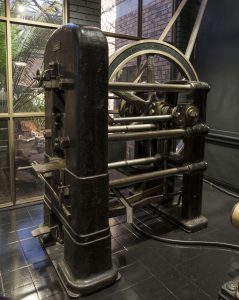
The legendary minting press that struck South African coins for 132 years — from President Kruger's first ZAR Pond in 1892 to the final NGC-pedigreed Krugerrand proof in 2024. One machine, three states, four locations, and one of the most extraordinary careers in mint history anywhere in the world.
One machine, 132 years
Built in Berlin in 1891 by Ludwig Loewe & Co. on the order of President Paul Kruger and shipped to Pretoria for the new ZAR Mint, the press was affectionately named Oom Paul — "Uncle Paul" — after Kruger himself. It was one of two presses ordered together; the other ran alongside it for the same eight years before British occupation.
Oom Paul outlived the Republic, the Boer War, the Royal Mint branch era, decimalisation, the entire apartheid period, and the move to Centurion. It is, by a wide margin, the longest-serving minting press in South African history — and quite possibly the longest in any modern Commonwealth context.
The order
1891 · Berlin · Royal Prussian Mint eraKruger's order to Ludwig Loewe & Co. in 1891 was placed alongside the broader contract with the Royal Prussian Mint for the first ZAR coinage. Two complete presses were specified — sufficient to give the new Pretoria Mint a redundant production capability from day one, with no reliance on London or Birmingham machinery.
The press arrived in Pretoria during the construction of the Mint and Bank buildings on Church Square. By 1892 it was striking the Republic's first locally-produced silver and bronze coinage; the gold came online with the corrected dies later that year. For the broader Berlin context, see the Berlin Mint Connection.
The Krugerrand press
1967 first · 2024 finalWhat makes Oom Paul's career singular is the Krugerrand. The press struck the very first 1967 Krugerrand — and 57 years later, in February 2024, it struck the last commemorative Krugerrands ever issued under its own pedigree.
The Krugerrand has become the world's most successful modern bullion coin. From its launch to its commemorative finale, the same machine struck both ends of that arc. The 2024 final-strikes carry the unique NGC pedigree "Final Oom Paul Krugerrands" — the only certification of its kind in numismatic history.
The career
Nine moments · 1891 – 2024Oom Paul's working life can be told as nine events across four custodial regimes: the ZAR (1892–1900), the Royal Mint branch (1923–1933), the South African Mint (1947 onwards), and Coin World (1996 to retirement). The 1967 first Krugerrand and the 2024 retirement are marked in ice — the two pivots that define the modern half of the press's life.
Berlin manufacture
Manufactured in Berlin by Ludwig Loewe & Co. on Kruger's order. One of two presses shipped together to Pretoria. Affectionately named Oom Paul — "Uncle Paul" — after Kruger himself, with the kind of familial nickname that no other minting machine has ever quite earned.
The ZAR era
Strikes over 8 million ZAR coins — gold Ponds and Half Ponds, silver Crowns, Florins, Shillings, Sixpences, and Threepences, plus bronze Pennies. After the fall of Pretoria in June 1900 and the British occupation of the Mint, the press lay idle for two decades.
The Royal Mint era
Recommissioned for the Royal Mint branch in Pretoria, striking gold sovereigns with the "SA" mintmark for export to Argentina, Australia, India, and other Empire destinations. The Berlin-built press now under British administrative control — minting British-system coinage for distribution across the British Empire.
The Royal Visit Crown
Strikes the Royal Visit Crown commemorating the 1947 visit of King George VI and Queen Elizabeth to South Africa — the first reigning monarch to visit. By this date the press had passed to South African government control under the renamed South African Mint.
The first decimal cent
Strikes the first decimal one-cent coins after South Africa's switch from the British system to the rand and cent on 14 February 1961. The press that struck the first ZAR Pond now strikes the first Republic of South Africa cent — both at the same moment of national monetary reinvention, sixty-nine years apart.
The first Krugerrand
Strikes the first Krugerrand on 3 July 1967 — the world's first modern bullion coin and, in due course, the largest-selling gold coin in history. The portrait of Kruger on the obverse is Otto Schultz's 1892 design, revived from the Berlin Münzkabinett archive. The press would go on to strike Krugerrand commemoratives for the next 57 years.
A second Oom Paul
A second Oom Paul press began operating at the Gold Reef City Mint, striking "GRC" mintmarked coins for the casino-museum operation. The original Oom Paul continued at the SA Mint; the two presses ran in parallel for over a decade, each producing distinct commemorative pieces.
Move to Coin World
When the SA Mint relocated to Centurion, the original Oom Paul press moved with it and was installed at the new Coin World museum. It continued as a working demonstration press, striking "CW" mintmarked R5 coins for visitors and the occasional special-edition piece. (See South African Mint Today.)
Retirement, after 132 years
After a final run of 1 oz and ¼ oz Krugerrand proof coins struck in 2022–2024, the press is retired. Each final-strike Krugerrand is certified by NGC with the special pedigree "Final Oom Paul Krugerrands." The press itself remains on permanent display at Coin World, Centurion — no longer producing coins, but visible to anyone who walks through the museum's doors.
The Final Oom Paul Krugerrands
2024 · Unique NGC pedigree"Final Oom Paul Krugerrands"
2024 · NGC-certified · 1 oz & ¼ oz proofsThe 2024 commemorative Krugerrand series is the only NGC-certified pedigree of its kind — coins certified not just by year and grade but by the specific machine on which they were struck. NGC's "Final Oom Paul Krugerrands" pedigree appears on the slab label of every coin struck on the press in its retirement run.
The pedigree creates a permanent, documented link between every single coin and the 132-year machine that produced it. For collectors, this is the rarest kind of provenance — not a hoard provenance, not a famous-collection provenance, but a machine provenance, attested by a third-party grading service at the moment of striking.
Each coin in the series is accompanied by a privy mark of the press itself and the 1892 founding date — a small numismatic gesture acknowledging that this is, in some sense, the last act of the original Pretoria Mint.
We were blown away that a 132-year-old press could produce coins in such amazing quality.
— Andy Salzberg · NGC- South African Mint — corporate communications, 2024 retirement press releases.
- NGC (Numismatic Guarantee Corporation) — "Final Oom Paul Krugerrands" pedigree announcements; statement by Andy Salzberg.
- Western Cape Numismatic Society — historical research, mint machinery and Royal Mint branch operations.
- Becklake, J.T. — mintage attribution research (1892 Berlin/Pretoria split).