Jardines Galleries · Royal Prussian Mint · 1891 – 1902
The Berlin Mint Connection.
How Prussian precision shaped South Africa's first coinage. From Otto Schultz's engraved dies to the Loewe-built Oom Paul press, this is the story of the German technical infrastructure that gave the Zuid-Afrikaansche Republiek its money — and a near-disastrous set of initials that almost cost Kruger an election.
With the Pretoria Mint still under construction and the crucial 1893 presidential election looming, President Paul Kruger urgently needed coins to demonstrate the Republic's sovereignty. He contracted the Royal Prussian Mint (Kaisermünze) in Berlin to strike the first ZAR coinage.
The choice was deliberately strategic — a counterweight to British influence, struck on the dies of one of Britain's continental rivals. The contract included every denomination, from gold Pond and Half Pond down to the bronze Penny, and was signed alongside an order for two minting presses from Ludw. Loewe & Co. Berlin would supply both the coinage and the machinery to keep producing it.
Consequence · The lasting legacy
The Berlin legacy
From 1892 to today
Three things from Berlin are still part of South African numismatics today: Schultz's portrait of Kruger, which has appeared on every Krugerrand struck since 1967; the Oom Paul press, one of the two 1891 Loewe machines, which remained in continuous service for 132 years until its 2024 retirement; and the die archive at the Berlin Münzkabinett, which still holds Schultz's original wax models and working dies.
The 1891 contract was an emergency political procurement. What it produced has outlived three states — the Republic, the Union, the modern democracy — and remains visible on every Krugerrand sold today.
Why Berlin?
A statement struck in metal
The Berlin contract has been read as a technical decision — Pretoria wasn't ready, Berlin was — but its real character was political. Kruger could have turned to the Royal Mint in London, which had the technical capacity and a long-standing relationship with the Cape and Natal colonies. He explicitly chose not to. By contracting the Royal Prussian Mint, the ZAR signalled that its sovereignty was the kind that Britain could not stamp.
At the cornerstone-laying ceremony for the new National Bank and Mint buildings on 6 July 1892, a lead casket was placed behind the stone containing a gold Pond, a gold Half Pond, and a silver Crown. President Kruger's speech referred to these as "die muntstukke van hierdie Republiek wat tot hede uitgegee is" — the coins of this Republic issued to date — suggesting that smaller denominations were not yet in circulation. (See the Foundation Stone Hoards for the full account.)
The contract scope was complete: gold Pond and Half Pond, silver Crown (5/–), Half-Crown (2/6), Florin (2/–), Shilling (1/–), Sixpence, and Threepence, plus the bronze Penny. Master and working dies were prepared in Berlin and shipped to Pretoria, and Berlin continued supplying dies even after the Pretoria Mint became operational in 1893.
Otto Schultz
Engraver · Berlin · 1848 – 1911
The engraver responsible for all ZAR dies was a seasoned Berlin artist — trained at the Loos medallic business, then with L.C. Wyon at the Royal Mint in London (gaining direct insight into British minting tradition), and finally Second Medallist at the Berlin Mint under Emil Weigand. By the time he was entrusted with the Transvaal coinage, he had a long list of engraving triumphs to his name. For the full biography, see People Behind the Coins.
— The signature scandal —
How an engraver's initials became an insult
Schultz signed his work the way medallists always signed their work — with his initials, O.S., set discreetly into the design of the early 1892 issues. In any other country it would have passed without remark.
In Afrikaans, os means "ox." Political opponents seized on the joke and used it to ridicule Kruger as the "ox" on the coins of his own Republic. The controversy nearly cost him the 1893 presidential election, which he won by a narrow margin. The initials were quickly removed from subsequent dies, and many of the offending coins were withdrawn from circulation and melted down.
The man whose initials caused the scandal went on to design a portrait that has outlasted his critics, his president, and the Republic itself.
O.S.
— engraver's initials —
↓
os
— Afrikaans —
↓
ox
— political insult —
Dies, mintages & the double-shaft affair
Berlin output · Withdrawal · Correction
The 1892 ZAR output was overwhelmingly Berlin work. The Pretoria Mint, in its first operational year, struck only a portion of the smaller silver denominations. Everything else came from the Royal Prussian Mint — including, after the O.S. controversy, the corrected replacement dies.
Mint attribution
What Berlin struck
Per J.T. Becklake's mintage research, the 1892 output divides cleanly:
Berlin (entirely): all gold Pond and Half Pond; the silver Crown, Half-Crown, Sixpence, Threepence; and the bronze Penny.
Pretoria (partial): a portion of the Florin (2/–) and Shilling (1/–) — possibly not until late in 1892.
Master and working dies were prepared in Berlin and shipped to Pretoria. Berlin continued supplying dies even after Pretoria became operational in 1893.
The withdrawal
The double-shaft affair
The original 1892 wagon design had two shafts — a "disselboom" error that drew political ridicule alongside the O.S. controversy. After the criticism, as many of the offending Pond, Half Pond, and Silver Crown as possible were withdrawn from circulation and melted down.
Corrected versions — single shaft, no engraver's initials — were issued later in 1892 from new Berlin-made dies. The melted originals are why the surviving double-shaft pieces are scarce today, and why they command the prices they do.
— Open question · Where did the gold come from? —
Was the gold used to strike these Berlin-made coins shipped from the Transvaal, or sourced in Germany? The contemporaneous documentation does not settle the question. See the dedicated research page: The Gold Behind the Coins.
The Berlin Münzkabinett
A living archive · ikmk.smb.museum
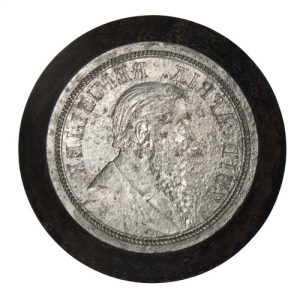
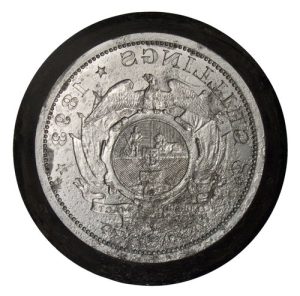
The former Prussian mint's die archive — now part of the Berlin Münzkabinett at the Bode-Museum — holds an extraordinary collection that goes far beyond coins. Schultz's original wax models, master and working dies for the ZAR series, and contemporary specimens acquired by the Mint at the time of striking are all preserved together. The archive is searchable through the Münzkabinett's online catalogue.
Holdings
What survives in Berlin
Wax models: Otto Schultz's original wax sculpts for the ZAR coinage — the creative source for every die.
Master & working dies: the actual tools used to produce the 1892 strikes.
Contemporary specimens: coins acquired at the time of striking, including object 18217925, an 1892 2½ Shillings (accession 1892/987).
Online catalogue: ikmk.smb.museum — research access available.
Significance
Why the archive matters
The Münzkabinett is the only place in the world that holds the physical chain of authorship for the 1892 ZAR series — from the engraver's wax model to the working die to the struck coin.
For ZAR research, it is the equivalent of the master tape — every other reference is a copy of a copy. Whenever a question arises about authenticity, the variety of a particular die state, or the nature of a strike error, the answer ultimately resides in Berlin.
HoldingObverse die / matrizeBerlin Münzkabinett · Reference
1891Manufactured in Berlin by Ludwig Loewe & Co. on Kruger's order.
1892 – 1902Strikes the first ZAR coinage in Pretoria.
1923 – 1960Mints Union of South Africa coinage under the Royal Mint branch.
1967Strikes the first Krugerrands — a Berlin-made machine puts a Berlin-engraved portrait into international bullion circulation.
2024Retired by the SA Mint after 132 years of continuous service. Special-edition 1 oz and ¼ oz Krugerrands struck on the press carry a privy mark of the press itself and the date 1892.
For the dedicated treatment, see the Oom Paul Press page.
Berlin contract
1891
Royal Prussian Mint
First ZAR strikes
1892
All gold · Most silver
Schultz's mark
O.S.
Removed mid-1892
Oom Paul retired
2024
After 132 years
— Sources —
Berlin Münzkabinett — online catalogue at ikmk.smb.museum; museum-digital reference holdings.
Western Cape Numismatic Society — research articles by Pierre H. Nortje.
Becklake, J.T. — mintage attribution research, foundational to ZAR/Pretoria mint allocation.
Hammerich, Hugo — Die Deutschen Reichsmünzen, Berlin Mint, 1905.
Noonans and Heritage auction archives.
South African Mint — press releases, 2024 (Oom Paul retirement).
Revision history
Page changelog
22 February 2026Expanded with detailed historical context, mintages, and the Oom Paul press legacy. Münzkabinett image badges added.