Monarchs
George V, George VI, Elizabeth II
Years
1923–1960
Denominations
Farthing to Crown
Mint
Pretoria Mint
Union Coinage (1923–1960)
The Union series marks the return of a nationally distinctive South African coinage after the ZAR period, struck in Pretoria under three monarchs and spanning the last full non-decimal era before the Republic’s decimal coinage began in 1961.
This period includes the major George V design changes, the George VI wartime and post-war issues, the celebrated 1947 Royal Visit Crown, and the final Elizabeth II Union issues. For collectors, it is one of the richest and most visually cohesive series in South African numismatics.
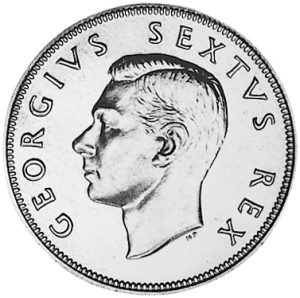
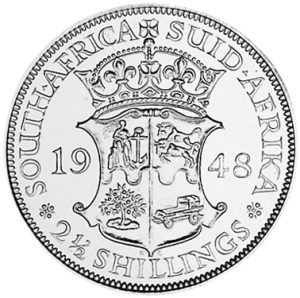
Featured Example — 1948 Two-and-a-Half Shilling
The half crown / 2½ shilling remains one of the flagship silver denominations of Union coinage. The 1948 issue sits within the George VI period and is an ideal representative specimen for the series.
Overview
In 1923, coinage for the Union of South Africa began to be struck in Pretoria, re-establishing a local minting tradition after the ZAR era. The Union series continued until the end of 1960, immediately before decimalisation and the introduction of Republic coinage in 1961.
Why this series matters
Union coinage sits at the centre of South African twentieth-century collecting. It combines strong historic context, attractive artistry, accessible base-level collecting, and real depth for advanced date, variety, and condition-based specialists.
Core characteristics
- Struck under George V, George VI, and Elizabeth II.
- Bilingual English and Afrikaans inscriptions.
- Non-decimal sterling system from farthing to crown.
- Strong design continuity with notable early type changes.
George V (1923–1936)
The George V period is the most structurally complex part of the Union series, with multiple early design phases and several denomination-level adjustments that make it especially attractive for type collectors.
| Denomination | First Coinage (1923–25/30) | Second Coinage (1925–30) | Third Coinage (1931–36) |
|---|---|---|---|
| Farthing (¼d) | Two sparrows (1923–24) | – | – |
| Half Penny | Ship (1923–26) | Ship (1926–30) | Ship (1931–36) |
| Penny | Ship (1923–24) | Ship (1926–30) | Ship (1931–36) |
| Threepence | Mimosa wreath (1923–25) | New design (1925–30) | Continued |
| Sixpence | Wreath (1923–24) | Protea (1925–30) | Protea (1931–36) |
| Shilling | Hope with beaded circle (1923–24) | Hope without beaded circle (1926–30) | Hope (1931–36) |
| Florin (2s) | Uncrowned shield (1923–30) | Same | Same (1931–36) |
| Half Crown (2/6) | Crowned shield (1923–25) | Crowned shield (1926–30) | Crowned shield (1931–36) |
Key collecting points
- 1923–1924 farthings are short-lived and historically important.
- 1925 Threepence is a major attention point with recognised variety interest.
- Bronze coins in top mint state become significantly tougher than many collectors expect.
Collector strategy
George V can be approached as a denomination-by-denomination study or as a design-transition set. The latter is harder, but far more representative of the artistic evolution of the Union series.
George VI (1937–1952)
The George VI period combines strong circulating coinage, changing metal contexts during and after the war years, and some of the most recognisable special issues in the broader Union series.
Structure of the reign
- First coinage: 1937–1947
- Second coinage: 1948–1950
- Third coinage: 1951–1952
Notable highlights
- 1947 Crown: Royal Visit issue with conjoined busts of George VI and Queen Elizabeth.
- Silver denominations: a major focus area for Union specialists.
- 1948 Half Crown / 2½ Shilling: a visually strong type within the later George VI run.
Featured Specimen — 1948 Two-and-a-Half Shilling
This example adds a proper visual anchor to the page and gives the Union section a museum-grade focal point. The denomination is commonly referred to as the half crown, or 2½ shilling.
Why this image pair works
The page previously read more like a text placeholder than a finished Jardines library article. These two images solve that immediately by giving the viewer a real Union coin to connect with.
On a full Union hub, this sort of featured specimen can later be extended into denomination-specific cards, date pages, proof/circulation distinctions, or a structured gallery linking into the deeper catalogue.
Elizabeth II (1953–1960)
The Elizabeth II Union issues represent the final chapter of South Africa’s pre-decimal coinage. They retained the familiar Union reverse system while updating the obverse to the young Queen’s portrait.
Historical role
These are transitional coins in every sense: politically close to the Republic period, visually continuous with the Union past, and chronologically the last of the old sterling structure.
Collector appeal
Elizabeth II Union issues are often easier entry points for collectors completing date runs, but top-grade examples and original surfaces still matter enormously.
Collecting Union Coinage
- Type set: the most approachable route, built around one example of each principal design.
- Date runs by denomination: ideal for collectors who want structure without tackling the entire series at once.
- Design-change set: materially harder and much more representative of the full Union story.
- Condition rarity: bronze and silver in premium mint state can become surprisingly scarce.
- Special focus areas: 1925 Threepence, early farthings, 1947 Crown, and top-grade George VI silver.
Sources
- Hern, Brian. South African Coins & Patterns / Standard Catalogue.
- PCGS Set Registry references, including major South African collections.
- Numismatic auction records, collector references, and standard South African cataloguing sources.